Sumikawa Law Office has adopted and published its Basic Policy on Customer Harassment, effective today. The Policy protects our staff and helps us continue providing proper legal services to all of our clients. The full Policy is available here.
Customer Harassment Measures Are Now Mandatory for All Employers in Japan
Under the June 2025 amendment to the Act on Comprehensive Promotion of Labor Policies, employers in Japan are legally required to take measures against customer harassment from today, October 1, 2026. The obligation applies to every employer, regardless of industry or size, and whether it serves consumers or businesses.
The guidelines issued by the Ministry of Health, Labour and Welfare require employers to do the following:
Adopt a policy of responding firmly to customer harassment and protecting employees, and communicate it to employees
Set up a consultation desk that can handle reports properly
When an incident occurs, establish the facts, support the affected employee and prevent recurrence
Decide in advance how to deal with particularly serious cases
Protect the privacy of employees who seek help, and prohibit unfavorable treatment for doing so
Employers that fail to comply may receive advice, guidance or recommendations from the Prefectural Labour Bureau. We can assist with drafting a policy and building the internal systems your business needs.
We have seen a growing number of inquiries from people living abroad who want to purchase real estate located in Japan. The basic flow of the transaction is the same as for a purchase made domestically, but there are a few points that require special attention. In this article, we outline the key considerations that overseas residents should keep in mind when purchasing property in Japan.
The Role of the Real Estate Agent
Support throughout the transaction—searching for a property, investigating its condition, and negotiating contract terms—is generally handled by a real estate agent (fudosan chukai gyosha). In Japan, no one may operate as a real estate agent without holding a license under the Building Lots and Buildings Transaction Business Act (which requires the presence of a licensed real estate transaction specialist, a national qualification). For this reason, most licensed agents can generally be trusted.
That said, even among licensed agents, some act in bad faith or engage in fraudulent practices. Since overseas residents cannot easily verify the situation in Japan firsthand, if you feel uneasy, it is worth considering a large, well-established agency—for example, one listed on a stock exchange. The credibility of the organization as a whole reduces the risk that the safety of the transaction depends solely on the qualities of a single individual agent.
On the other hand, for relatively low-priced properties—such as an old vacation home in a rural area—large agencies often do not actively handle such listings in the first place. For these properties, it may be more reassuring to work with a local agency that has been operating in that area for many years, as such agencies tend to be more familiar with the actual condition of the property and the surrounding circumstances.
The Biggest Hurdle: Payment of the Purchase Price
For overseas residents purchasing real estate in Japan, the single biggest practical hurdle is the payment of the purchase price.
In a typical Japanese real estate transaction, settlement proceeds as follows:
An earnest money deposit (tetsukekin) is paid at the time the contract is signed.
Once preparations for registration are complete, the balance of the purchase price is paid.
Simultaneously with payment of the balance, the buyer receives the title deed (registration identification information) from the seller.
For a domestic transaction, a bank transfer allows the funds to be confirmed as received on the same day, which makes this “simultaneous performance” easy to achieve. With an international wire transfer, however, it is common for the funds to take several days to arrive, so same-day confirmation of receipt is not possible. This creates a real risk: the buyer may have already sent the funds but cannot obtain the title deed until receipt is confirmed, or the seller may be unwilling to hand over the title deed before the funds have actually arrived.
In addition, escrow services are not yet widely used in Japan. In some countries, such as the United States, escrow is a standard part of real estate transactions, in which a neutral third party holds the funds temporarily and releases them to the seller only once the agreed conditions are satisfied. Japan currently lacks this kind of institutional framework.
Using a Lawyer’s Trust Account
One way to address this timing gap is to make use of a lawyer’s trust account (client account).
Where a lawyer has been retained to review the sale and purchase agreement, or to act as agent in the sale and purchase procedure itself, the buyer can transfer funds into the lawyer’s trust account in advance, and the lawyer can then transfer the funds to the seller’s account on the settlement date. This arrangement allows:
The buyer to prepare and remit funds well before the settlement date; and
The seller to hand over the title deed with confidence that the transfer from the lawyer’s account will actually be made on the settlement date.
In this way, the arrangement can achieve a function similar to an escrow arrangement, even without a dedicated escrow service.
It is important to note that a lawyer cannot be retained solely for the purpose of moving funds. Use of a trust account presupposes that the lawyer has been retained to perform substantive legal work—such as reviewing the contract or acting as agent in the transaction.
Summary
When purchasing real estate in Japan as an overseas resident, the key points are:
Choosing between a large agency and a local, community-based agency depending on the price range and nature of the property;
Understanding the structural problem created by the timing gap in international wire transfers at settlement; and
Reducing settlement risk by retaining a lawyer to review the contract or act as agent in the transaction, and making use of the lawyer’s trust account.
If you are considering purchasing real estate in Japan from overseas, consulting a lawyer at an early stage—so that the settlement method is planned as part of the overall transaction—can help ensure the process goes smoothly and safely.
Navigating inheritance in Japan as a foreigner? Learn the basics of Japanese inheritance law, applicable laws, and the importance of a will. Sumikawa Law Office, English-speaking lawyers near Tokyo, can assist.
(Introduction) When a foreign national living in Japan, or a foreigner who owns property in Japan (like real estate or bank accounts), passes away, their family faces a complex question: how is the inheritance handled? International inheritance law can be challenging.
Here is a brief overview of what foreigners need to know about inheritance in Japan.
Which Country’s Law Applies? (Governing Law)
Many people assume Japanese law automatically applies to assets in Japan. However, Japan’s private international law states that inheritance is generally governed by the law of the deceased person’s nationality (their “home country law”).
Example: If an American citizen passes away, US law (specifically, the law of their state) generally governs their entire estate, including their property in Japan.
However, there are exceptions, and the process itself (like registering real estate or releasing bank accounts) must still follow Japanese procedures, which can create conflicts or complications.
The Critical Role of a Will (Yuigon)
Because different countries’ laws may be involved, having a valid Will (遺言, Yuigon or Igon) is important for foreigners connected to Japan.
A Will can simplify the process immensely for your heirs. It helps clarify who should inherit your assets, regardless of where they are located. For assets in Japan, creating a Will that is legally valid in Japan (such as a Notary Deed Will) can make the procedures at Japanese banks and legal affairs bureaus significantly smoother for your family.
What If Japanese Law Applies?
In some cases (for example, if the deceased’s home country law directs back to the law of the location of the assets), Japanese law may apply. Under Japan’s Civil Code:
The spouse is always an heir.
Children (or their descendants) are the first in line (along with the spouse).
If there are no children, parents (or grandparents) are next.
If none of the above exist, siblings become heirs.
Professional Advice & Mandatory Registration
International inheritance involves complex legal issues, differing procedures, and potential language barriers. Waiting too long can lead to frozen assets and difficult disputes.
Furthermore, a recent change in Japanese law now makes it mandatory to register inherited real estate within three years of learning of the inheritance. This new rule makes timely and accurate procedures essential if you inherit real estate in Japan.
If you are dealing with an inheritance matter in Japan or wish to prepare a Will, seeking professional advice early is crucial. The English-speaking attorneys at Sumikawa Law Office are experienced in supporting foreigners with Japanese inheritance law and procedures. Contact us for a consultation.
Thank you for visiting our website. We are a law firm in Japan, and we often receive inquiries from those looking for a Japanese lawer to assist with visa and immigration matters.
Please be advised that our firm does not handle cases related to visas or status of residence in Japan.
For assistance with these matters, we recommend searching online for terms such as “visa lawyer Japan.” This should provide you with a list of qualified professionals who specialize in this area of law.
Additionally, if you are considering starting a business in Japan and require assistance with visa applications in that context, we can recommend the Kawasaki One-Stop Business Startup Center. We collaborate with this organization, and they are equipped to handle visa consultations for entrepreneurs. To request a consultation, please visit their website directly at https://onestop-kawasaki.com/.
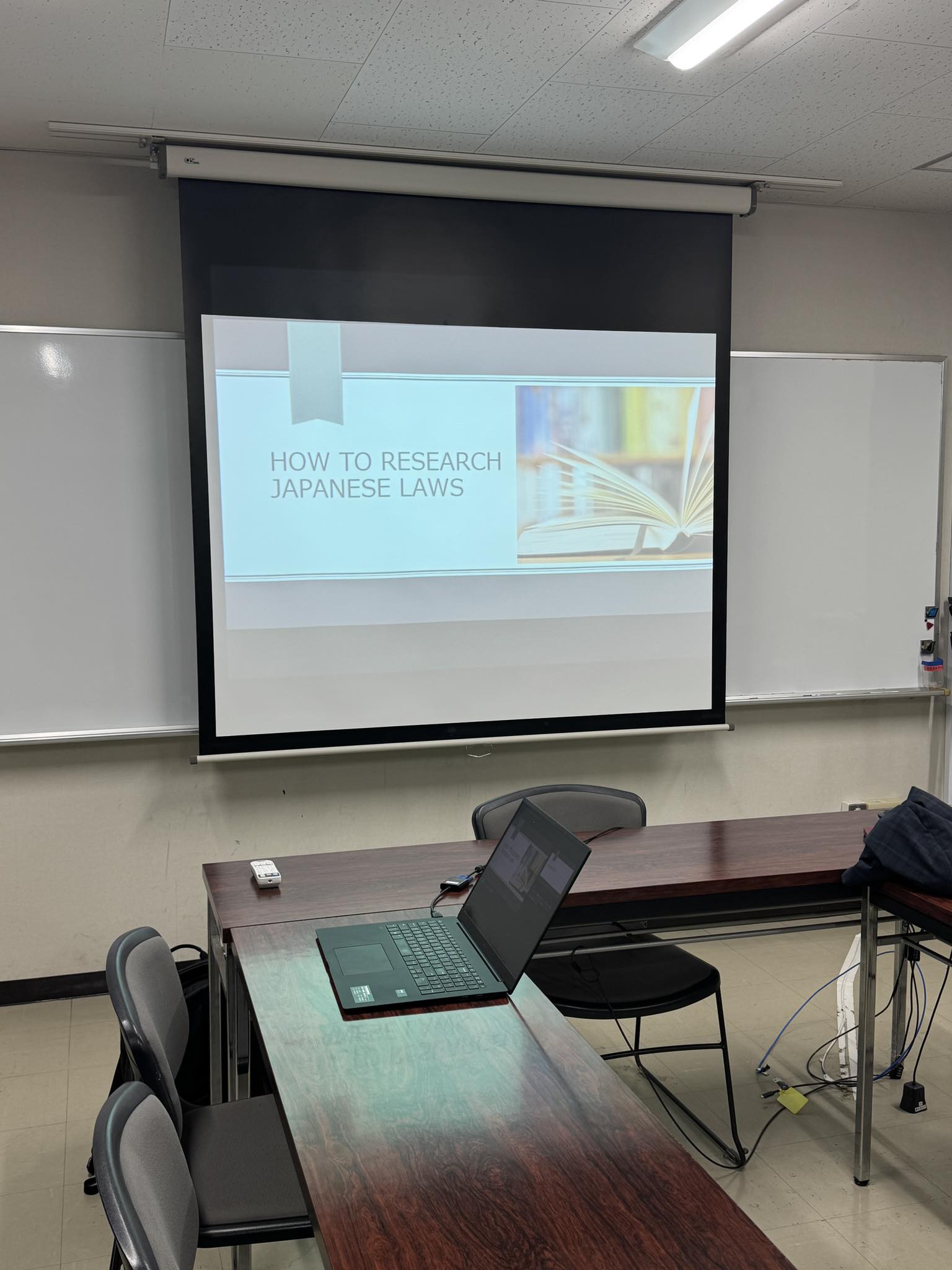
For the current academic year, I (Sumikawa) have been appointed as a guest professor at the Yokohama National University Graduate School, where I am teaching a course on Japanese law for international students.
All lectures are conducted entirely in English. To accurately convey the unique characteristics and practical applications of the Japanese legal system to students from diverse legal backgrounds, extensive and time-consuming preparation is required. Being new to university lecturing, each class presents its own challenges, but at the same time, it is a highly rewarding experience.
Although the course lasts for only one semester, the dialogue with these enthusiastic students from various countries is a truly stimulating experience. In response to their proactive questions, I draw upon my full command of English, though it can be frustrating at times not being able to provide explanations as smoothly as I would in Japanese.
Through this opportunity, I hope to impart practical knowledge and legal ways of thinking that will be of use to the students in their future careers.